


From:Rocky Hill War Memorial Museum
Name/TitleVarious models of ships -
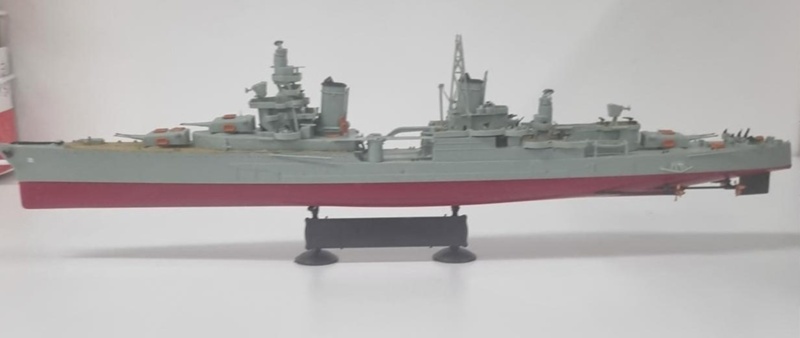
1. U.S.S. (CA-35) Indianapolis.
2. Admiral Graf Spee.
3. British Battleship King George V.
About this objectHandmade model ships including -
1. U.S.S. Indianapolis (CA-35) on a black plastic stand with the name of the ship.
U.S.S. Indianapolis (CA-35) was a Portland-class heavy cruiser of the United States Navy, launched in 1931 and commissioned in 1932. During World War ll, she served extensively in the Pacific Theatre and earned ten battle stars for her wartime service. The ship frequently served as the flagship of Admiral Raymond Spruance's Fifth Fleet and participated in major operations including the Aleutian, Gilbert, Marshall, Mariana, and Okinawa campaigns.
In July 1945, Indianapolis completed a highly secret mission, transporting components and enriched uranium for the atomic bomb later used at Hiroshima to the American base on Tinian Island. After successfully delivering the cargo, the cruiser departed Guam bound for Leyte in the Philippines. Shortly after midnight on 30 July 1945, she was torpedoed by the Japanese submarine I-58 and sank in approximately twelve minutes.
Of the 1,195 men aboard, about 300 were lost with the ship. The remaining survivors spent over four days in the open ocean awaiting rescue. Exposure, dehydration, injuries, and shark attacks contributed to the loss of many lives. Only 316 crewmen survived, making the sinking of Indianapolis one of the greatest tragedies in United States naval history.
The story of U.S.S. Indianapolis remains a powerful reminder of the sacrifices made by naval personnel during World War ll. The ship's final mission, tragic loss, and the endurance of her survivors have ensured her place as one of the most well-known and significant vessels in American naval history.
2. Admiral Graf Spee on a grey plastic stand with the name of the ship.
Admiral Graf Spee was a German Deutschland-class heavy cruiser, commonly referred to by the British as a "pocket battleship." Commissioned in 1936, the ship was named in honour of Admiral Maximilian von Spee, a German naval commander killed during the First World War. Designed to combine heavy armament with high speed and long range, Admiral Graf Spee was intended to operate as a commerce raider, capable of threatening merchant shipping while avoiding larger enemy warships.
At the outbreak of the Second World War, Admiral Graf Spee was deployed to the South Atlantic and Indian Oceans, where it conducted a successful campaign against Allied merchant shipping. Between September and December 1939, the vessel sank nine merchant ships totalling more than 50,000 tons. Captain Hans Langsdorff gained a reputation for adhering to naval traditions by ensuring the safety of civilian crews before their vessels were sunk.
On 13 December 1939, Admiral Graf Spee engaged three British Commonwealth cruisers, HMS Exeter, HMS Ajax, and HMNZS Achilles, in the Battle of the River Plate, the first major naval battle of the Second World War. Although the German ship inflicted significant damage on its opponents, it also sustained critical damage and sought refuge in the neutral port of Montevideo, Uruguay. Believing superior British forces were waiting outside the harbour, Captain Langsdorff ordered the ship to be scuttled on 17 December 1939 rather than risk further battle.
The loss of Admiral Graf Spee was an early Allied naval success and became one of the most famous naval episodes of the war. The ship remains an enduring symbol of commerce raiding, naval strategy, and the dramatic events of the Battle of the River Plate.
3. British Battleship King George V with a black plastic stand with the name of the ship.
HMS King George V was the lead ship of the Royal Navy's King George V-class battleships and one of Britain's most important capital ships during the Second World War. Laid down in 1937 and commissioned in 1940, she was named in honour of King George V and served as the flagship of the British Home Fleet for much of the war. The battleship was heavily armed, carrying ten 14-inch guns, and represented the most modern battleship design in Royal Navy service at the outbreak of the conflict.
HMS King George V operated in the Atlantic, Mediterranean, and Pacific theatres, participating in many significant naval operations. In May 1941, she played a crucial role in the pursuit and destruction of the German battleship Bismarck, one of the most famous naval actions of the war. The ship later supported the Allied invasion of Sicily in 1943 and participated in operations against Japanese forces in the Pacific during the final stages of the war.
As one of the Royal Navy's principal battleships, King George V symbolised British naval power and the continued importance of battleships during the Second World War. Her service record earned battle honours including Atlantic 1941, Bismarck 1941, Arctic 1942-43, Sicily 1943, Okinawa 1945, and Japan 1945.
Following the war, HMS King George V continued in service before being placed in reserve and eventually scrapped in 1957. Today she is remembered as one of Britain's most distinguished wartime battleships and a key participant in several of the Royal Navy's most important naval operations of the twentieth century.
MakerUnknown
Maker RoleCreator
Date Madec.2023
Period21st-century
Place MadeGoulburn, Australia
Medium and MaterialsPlastic, glue.
Style and IconographyHand made
Inscription and MarksThe names of the ships are printed on the stands the models are placed.
TechniqueManufactured
Measurements1. 530mm x 50mm (tapering to a point at both ends).
2. 540mm x 65mm (tapering to a point at both ends).
3. 640mm x 90mm (tapering to a point at both ends).
Subject and Association KeywordsWorld War ll
Subject and Association DescriptionThese models were donated together with a group of 4 tanks used during WWll, and various models of soldiers of WWll.
Object TypeMemorabilia
Object number2026.1084.3
Copyright LicenceAll rights reserved
