


From:Rocky Hill War Memorial Museum
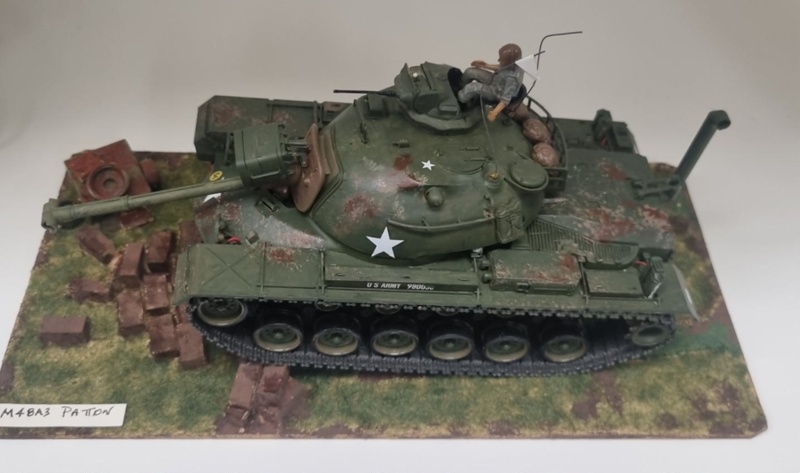
Name/TitleVarious Tank Models - M48A3 Patton tank; U.S. Marine M60A1Tank; Challenger 1 (Mk.3); Cromwell Mk.IV British Cruiser Tank.
About this object4 Model tanks made by a Goulburn resident including:
1. M48A3 Patton Tank.
The M48A3 Patton was an American main battle tank introduced during the Cold War and widely used during the Vietnam War. It was an improved version of the earlier M48 tank, featuring a more reliable diesel engine and greater operational range.
Armed with a 90 mm main gun and protected by heavy armour, the M48A3 served with the U.S. Army and Marine Corps, where it was valued for its firepower and survivability. It was particularly effective in providing infantry support and attacking fortified positions.
With a crew of four, a top speed of approximately 48 km/h, and a combat weight of around 50 tonnes, the M48A3 became one of the most recognizable American tanks of the Vietnam era. More than 12,000 M48 tanks of all variants were produced, and many served with allied nations around the world.
Significance: The M48A3 Patton represents a key stage in the development of Cold War armoured warfare and is best known for its extensive service in Vietnam, where it demonstrated the continuing importance of tanks in modern combat.
2. U.S. Marine M60AI W/Reactive Armor.
The M60A1 was a second-generation American main battle tank that served as the primary tank of the U.S. Marine Corps during the Cold War and into the Gulf War era. Developed from the M48 Patton series, it featured a 105 mm M68 main gun, improved armour protection, and a 750 hp diesel engine.
Marine Corps examples were later fitted with Explosive Reactive Armor (ERA), consisting of armour blocks mounted on the turret and hull to improve protection against anti-tank rockets and missiles. Tanks equipped with ERA saw service during Operation Desert Shield and Operation Desert Storm in 1990 to 1991.
Significance: The M60A1 with Reactive Armor represents the adaptation of Cold War armoured technology to modern battlefield threats. It was the principal tank of the U.S. Marine Corps for many years and played an important role during the Gulf War, where its firepower, protection, and reliability contributed to successful coalition operations.
3. Challenger I (Mk.3).
The Challenger 1 Mk.3 was a British main battle tank introduced in the 1980s as the principal armoured fighting vehicle of the British Army. Developed from the earlier Shir 2 project, it featured advanced Chobham composite armour, providing one of the highest levels of crew protection of its era.
Armed with a 120 mm L11A5 rifled gun and powered by a 1,200 hp diesel engine, the Challenger 1 combined formidable firepower with good mobility and battlefield endurance. The Mk.3 variant incorporated improved armour protection and upgraded electronic systems.
The Challenger 1 gained international recognition during the 1991 Gulf War, where British Army tanks achieved an exceptional combat record and demonstrated the effectiveness of their armour and long-range gunnery.
Significance: The Challenger 1 Mk.3 represents a major advance in British armoured vehicle design and is notable for its combat success during the Gulf War. It exemplifies the development of modern main battle tanks and the importance of advanced armour technology in late twentieth-century warfare.
4. Cromwell Mk IV British Cruiser Tank.
The Cromwell Mk IV was a British cruiser tank developed during the Second World War and first saw combat in Normandy following the D-Day landings in June 1944. It was one of the fastest British tanks of the war, powered by the reliable Rolls-Royce Meteor V12 engine, which gave it excellent mobility and made it well suited to reconnaissance and rapid advances across enemy territory.
Armed with a 75 mm gun and protected by armour up to 76 mm thick, the Cromwell Mk IV carried a crew of five. Although it was not as heavily armed or armoured as some German tanks, its speed, manoeuvrability, and reliability made it highly effective in fast-moving operations across North-West Europe.
The Cromwell served with British and Commonwealth armoured units throughout the final stages of the war and remained in service for several years afterwards. More than 4,000 Cromwell tanks of all variants were produced.
Significance: The Cromwell Mk IV represents the evolution of British armoured warfare during the Second World War. Renowned for its speed and reliability, it played an important role in the Allied advance across Europe and helped establish the foundations for later British tank designs such as the Comet.
MakerUnknown
Maker RoleCreator
Date Madec.2023
Period21st-century
Place MadeGoulburn, Australia
Medium and MaterialsPlastic, glue.
Style and IconographyHand made
Inscription and MarksThe name of the tank is attached to the base of the model.
TechniqueModel making
Measurements1. M8A3 - 300 x 170mm.
2. M70AI - 300 x 150mm.
3. Challenger I (Mk 3) - 270 x 125mm.
4. Cromwell Mk I - 300 x 170mm.
Subject and Association KeywordsModel Tanks
Object TypeMemorabilia
Object number2026.1084.1
Copyright LicenceAll rights reserved
