


From:Rocky Hill War Memorial Museum
Name/TitleH.M.S. Dart Sailor's Cap
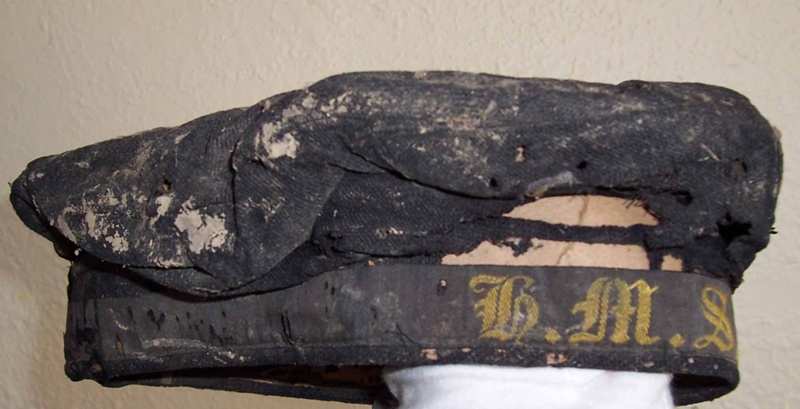
About this objectDark navy-blue sailor's cap constructed from wool cloth with remnants of an internal lining and leather sweatband. The cap is heavily deteriorated, having been folded and compressed for an extended period. Gold-painted lettering on the cap band reads "H.M.S. Dart", identifying the vessel to which the owner was attached. Significant losses to the crown and lining are evident, with extensive surface soiling, deformation and insect damage.
This sailor's cap from H.M.S. Dart was discovered by Eric Weston of Goulburn during the demolition of the East Goulburn Public Hall in 2000. The cap was found concealed within a wall cavity directly beneath a nail and associated with the remains of a hemp string, indicating it had once been suspended from the wall before being enclosed within the building fabric.
The East Goulburn Public Hall, later known as the Eastgrove Public Hall, was constructed in 1924 on Hercules Street, Goulburn. Built by Messrs Holland and Frost with assistance from local volunteers, the weatherboard hall served as an important community meeting place for many decades.
The deliberate concealment of the cap is consistent with a long-standing folk tradition documented throughout Europe, North America and Australia. Scholars have identified numerous examples of clothing, shoes and personal possessions hidden within walls, ceilings and under floors of buildings. These concealed deposits, known as "caches," were often intended to act as protective charms, bring good fortune, ensure prosperity, or ward off evil influences. The practice dates back to the medieval period and continued into the twentieth century.
The style of lettering on the cap suggests a late nineteenth-century origin. It is believed to have belonged to a sailor serving aboard H.M.S. Dart during its service with either the Royal Navy or, following its transfer, the New South Wales Government. The original owner may have later settled in the Goulburn district and worked on the construction of the hall, or the cap may have been retained as a family keepsake before being concealed within the building.
H.M.S. Dart was launched in 1877 by the Barrow Shipbuilding Company as the private yacht Cruiser. Acquired by the Colonial Office for use by Sir Arthur Hamilton Gordon, Governor of Fiji, the vessel was later purchased by the Royal Navy in 1882 and renamed Dart.
Assigned to the Australia Station in 1883, Dart undertook extensive hydrographic survey work throughout Australian, New Zealand and Pacific waters. The vessel contributed significantly to the charting of Fiji, the Gilbert and Ellice Islands, the Marshall Islands, New Britain, Tasmania and other regions of the South Pacific. Notably, Dart surveyed Port Arthur and the Isle of the Dead in 1893, producing Admiralty Chart No. 1475.
The vessel remained in service until 1904, when it was transferred to the New South Wales Government as a training ship. It was subsequently sold to the Victorian Government in 1912 and later entered private ownership before being sold to French interests in Nouméa in 1920.
MakerUnknown
Maker RoleUnknown Royal Navy or New South Wales Government
Date Madec.1882–1904
PeriodLate-19th century-early 20th century
Place MadeLikely United Kingdom of Great Britain and Nothern Ireland
Medium and MaterialsWool cloth, cotton lining, leather band, painted/gilt lettering
Style and IconographyTailored textile construction
TechniqueMachine sewn; tailored; painted lettering
Measurements40.54mm x 7.62mm
Subject and Association KeywordsHMS Dart
Subject and Association KeywordsEastgrove Public Hall
Subject and Association KeywordsConcealed Objects
Subject and Association DescriptionThe H.M.S. Dart sailor's cap is significant as a rare surviving example of late nineteenth-century naval headwear associated with a vessel that played an important role in the hydrographic surveying of Australian and Pacific waters. The object possesses historical significance through its connection with H.M.S. Dart and the broader maritime history of the Royal Navy in Australia, and being a historic concealed object.
Its association with Goulburn further enhances its local significance, linking maritime history with community life and the construction of one of the city's early twentieth-century public buildings.
Object TypeTextile
Object number2005.133.1
Copyright LicenceAll rights reserved
PDF FilesEastgrove Hall
