


From:Rocky Hill War Memorial Museum
Name/TitleCollection of Coins and Japanese Invasion Money.
About this objectWebbing pouch and embroidered small bag which was used to store the coins and invasion money when donated.
Collection of coins from various countries including -
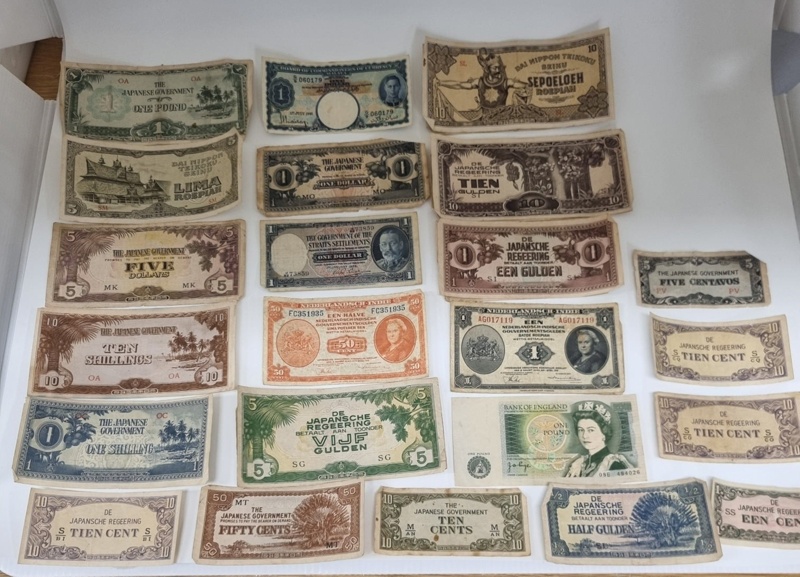
PAPER INVASION MONEY –
De Japansche Regeering Tien Cent (10)
The Japanese Government Ten Cents (10)
The Japanese Government Five Centavos
The Japanese Government One Shilling
The Japanese Government Ten Shillings
The Japanese Government Five Dollars
The Japanese Government 50 cents
Dai Nippon Teikoku Seihu Sepoeloeh Roepiah (10) x 2
De Japansche Regeering Tien Gulden x 2, 5 Gulden x 2 , 10 Gulden, Een Gulden x 2, ½ Gulden
De Japansche Regeering Tien Cent, Een Cent
Bank of England One Pound
Board of Commissioners of Currency Malaya One dollar 1st July 1941
Dai Nippon Teikoku Seihuy Lima roepiah 5
The Japanese Government One Pound
The Government of the Straits Settlements One Dollar
The Japanese Government One Dollar
De Japansche Regeering Ten Cent
Nederlandsch Indische One x 2, 50 Cent
COINS
New Zealand 6d 1946
New Zealand Half Penny 1959
Liberte Egalite Fraternite 1974
Rzecz Pospolita Polska 1992
CCCP – Korenka 1 Anna 1940
India 2 Annas 1918
Great Britain 3d 1907
Chinese Qing Dynasty 1736-1795 (Holy) x 5; 1938, c1880
Japanese 1 yen
Commissioners of Malaya 1cent 1940 x 12, 1945 x 3; 1848 x 1
Straits Settlements 1 cent 1920 & 1926
Nederlandsh Indie 1c x 11 1942 & 1920
Nederlandsh Indie ½ cent 1933, 1857, Very worn (illegible)
Nederlandsh Indie ¼ cent 1942
Malaya 9 x 5 cents 1941
13.10 cents 1941
3 x 20 cents 1945
1 x 20 cents 1948
Sarawak 1 cent 1930 x , 1937 x 2,
2 cent 1927, 1934
Borneo (Malay, British Borneo) 1 50c 1961
State of North Borneo 1c 1935
2½ 1903
Territory of New Guinea 1/- 1938 x 4; 1936 x 1
Hong Kong 10c x 3 1957, 1963, 1964
Spanish 25 peseta 1990, 1991, 1994
Spanish 100 peseta 1998
American 1 dime 1941, 1989,
American ¼$ 2007
American 5c 1939
American 1c 1990 x 3,1989 x 1;1917,1930,1935,1940,1942
American 10c 1939
Sarawak 10c x 1927, 1934
Netherlands East Indies 1c x 2 1820, 1857.
Japanese invasion money—often called “JIM” or “banana money”—refers to currency issued by Imperial Japanese Government during the Second World War for use in territories occupied by Japan across Asia and the Pacific.
These notes replaced local currencies in occupied regions such as Malaya, Singapore, the Philippines, and parts of New Guinea. They were issued in denominations similar to the pre-war currencies but were not backed by gold or reserves.
Often simply designed, sometimes featuring local imagery (like banana trees in Malaya—hence “banana money”)
Printed in large quantities without strong economic controls
Carried Japanese script and sometimes promises of future value
The currency helped Japan: Control local economies; Pay troops and labourers; Extract resources without using Japanese domestic currency
Problems and collapse
Because it was overprinted and had no real backing, inflation quickly became severe. As the war progressed, the money lost almost all value. After Japan’s defeat in 1945, invasion money became worthless overnight.
Today, Japanese invasion money is a common wartime artefact. It provides insight into occupation policies, wartime economies, and the daily lives of civilians under Japanese rule. It’s often found in WWII collections and sites—especially in areas like New Guinea, where occupation forces operated.
MakerVarious sources
Maker RoleManufacturer
MakerJapanese Government
Maker RoleManufacturer
Date MadeVarious Dates
Period20th-century
Place MadeVarious
Place NotesMade by various Governments.
Place MadeJapan
Place NotesMaker of the Japanese Invasion Money.
Medium and MaterialsJapanese Invasion Money, issued by the Empire of Japan during World War II, was produced using inexpensive, readily available materials suited to rapid wartime printing.
The notes are printed on paper, generally a low grade wood pulp paper rather than high-quality rag paper used in pre-war banknotes. The paper is typically thin, fibrous, and often shows signs of deterioration such as brittleness, staining, or discolouration, especially in later issues when material shortages were severe.
Style and IconographyPrinted
Inscription and MarksOn Japanese Invasion Money issued by the Empire of Japan during World War II, inscriptions were generally simple and functional. They typically include:
The issuing authority name (often in Japanese, referring to the occupying government or military administration). The denomination (shown in both local language and Japanese script). Serial or series codes (letters and/or numbers on many issues). Overall, inscriptions were minimal, standardised by region, and designed for rapid wartime production rather than aesthetic or security purposes.
TechniquePrinting
MeasurementsCoins - various sizes.
Notes -
56 x 119mm x 6; 75 x 158 x 2; 75 x 155 x 5; 54 x 140 x 4; 65 x 125 x 2; 70 x 130 x 2; 47 x 95 x 1; 45 x 95 x 1; 66 x 135 x 1; 70 x 156 x 3; 70 x 124 x 1
Subject and Association KeywordsWartime
Subject and Association KeywordsCoinage
Named CollectionDay Collection
Object TypeCoins
Object number2025.991.2
Copyright LicenceAll rights reserved
